Many years ago, I was a child attending school in my village. There I learned that I lived on an island and that an island is a piece of land surrounded on all sides by sea.
No one ever told me about the waves that come, sometimes stormy, or the heavy winds. I have learned over the years that you are not spared from the gusts of wind or the waves. A verse by Ausiàs March now comes to mind: ‘Foll is he whom the steady wind wanted’. And this leads me precisely to the artistic, seductive and admirable work of PERE PAVIA.
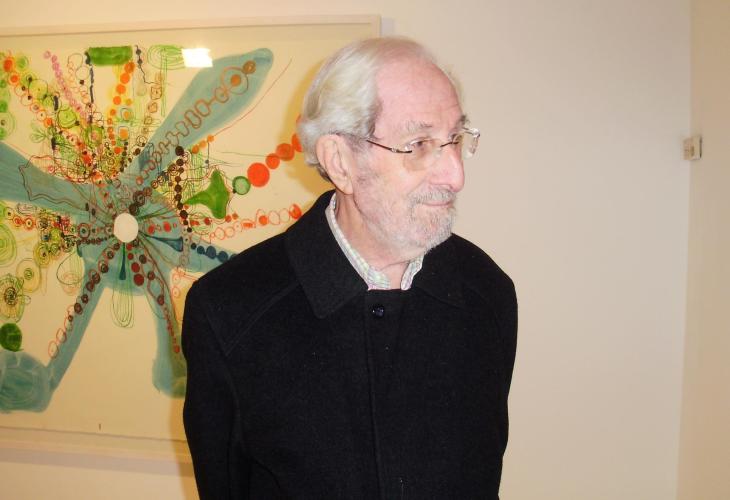
I see him, the artist, as an island on which all the winds of contemporary art come to fall, the most dazzling currents of creation.
On his painter’s palette, on the tip of the draughtsman’s pencil, in the circle of the sculptor who carves angels and chimeras, came the great enigmas of the artistic creation of a century that seduces and thrills at the same time.
I am referring to the 20th century and the first decades of the current century. I would say that the hands of PERE PAVIA – remember that verse from Raimon’s song: ‘always look at a man’s hands’ – contained the creative force that came to him from all directions. The turbulent Europe of the second half of the century has marked his steps: the extreme greyness of the dictatorship, the tensions of the Cold War, the post-Franco era. All historical events also find their way onto his canvases and the stones he works on.
Expressionism, surrealism, cubism, even pop art influence him and shape his imagination. He admires Picasso, Joan Miró, Magritte, and Andy Warhol. And he explores the magic that lies hidden in the smallest things.
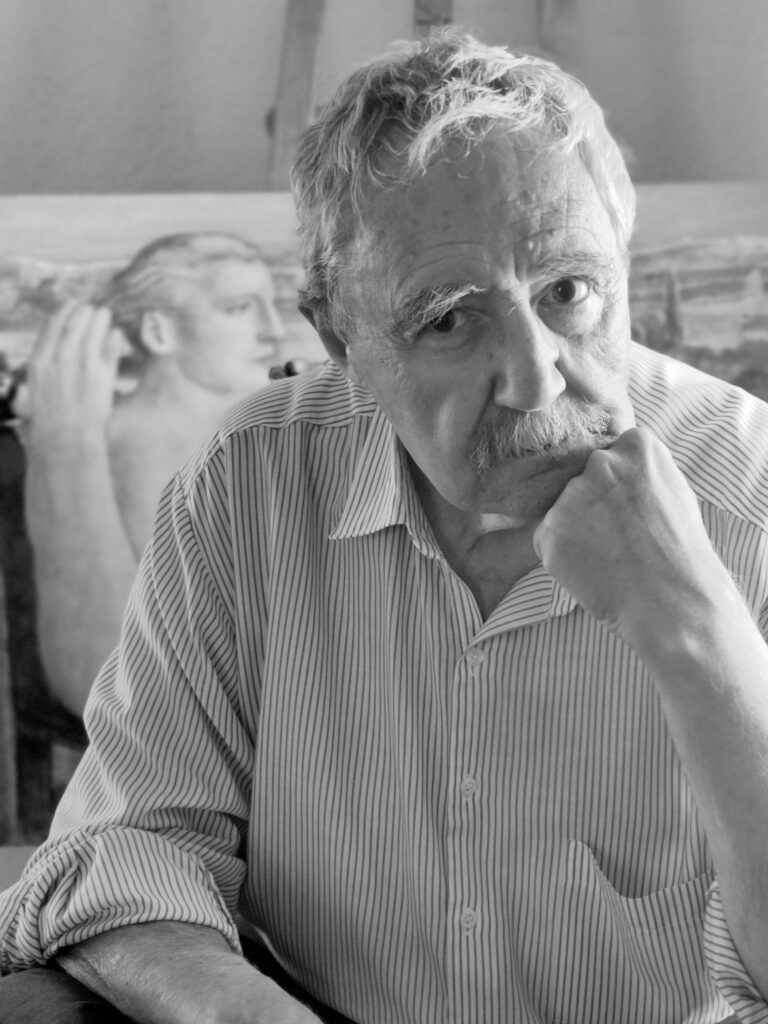
For PERE PAVIA, a natural avant-gardist, art is above all experimentation, which is why he is part of the artistic and cultural ferment that marks his time. He likes provocation, because he believes that artistic practice should be unsettling, and he refines forms, plays with volumes, leans towards abstraction and geometric games – I am thinking now of the painting entitled ‘pecho-jarra’ (breast-jug) – and juxtaposes often solitary objects in an atmosphere that strains reality only so that it can be represented. When he paints portraits – think now of the portrait of Cisca, that of Francesc de B. Moll, that of Longino, the self-portrait – he gives the impression that the character in the painting is looking at us and questioning us. He shuns academicism, takes risks and breaks with established artistic canons. He wanted to take art out of museums and academies and bring it into contact with ordinary people, with whatever came along. He wanted to modernise and stimulate the society of his time through art, to spread his playful vision of reality and the freedom of creation. He then became a leading figure in contemporary art in Mallorca in our time, an innovator who absorbs what the waves and winds bring to ultimately create his synthesis.
His themes bear the mark of his work as a sculptor. Sometimes it will be a play of curves, a mutilated body, a male torso. Some paintings in the abstractions series have made me think of Juli Ramis’ feminine dunes. But there is also humour, in some cases cruel: the ‘sausage woman’, the ‘commonplace point’, the ‘pair of red eggs’. And surrealism: the ‘plug woman’, the ‘bloody Mallorca’. PERE PAVIA felt the attraction of theatre and explored the meanings of each movement of the body, precisely because he came from the world of sculpture.
Just when the theatre group ‘Els Joglars’ was starting out, they came to Palma and performed in the auditorium of the school of Sant Francesc. Afterwards, Albert Boadella taught a mime course that I attended.
He made us work on the expression of a verse through body movements and introduced us to the great Marcel Marceau through projections. We learned how to stimulate laughter or smiles in people through silence. After that course, PERE PAVIA created the group ‘Farsa’ and popularised the character of the Innocent.
For years he devoted himself to theatre education and, almost magically, was able to combine the visual arts with literature and theatre. And he imbued everything he did with a luminous sensuality. He never stopped being a rebel. Look at his black and white oxen, the expression on the faces of the monkeys he draws, look, if you will, at some of his sunsets.
GABRIEL JANER MANILA
November 2025
Links of interest: